
What Is PPC? Pay-Per-Click Advertising Explained
PPC stands for pay-per-click. It is a type of online ad where you pay only when someone clicks your ad, not when they see it. Google Ads is the biggest PPC platform, but Microsoft Ads (Bing), Facebook, Instagram, TikTok and YouTube all sell ads the same way. If you would rather have someone run it for you, see our PPC management.
Do you ever see your competitors at the top of Google and wonder how they got there? Most of the time, they paid for that spot, and you can too.
We run PPC for small businesses, and Jonathan is Google Ads certified. This guide covers what PPC means, how the ad auction really works, what a click costs and how to start without wasting money.
What does PPC stand for?
PPC means pay-per-click: you set up an ad, pick who should see it, and the platform charges you each time someone clicks it.
You may also hear it called paid search, search engine marketing (SEM) or cost-per-click (CPC) ads. Paid search and SEM usually mean ads on search engines only. CPC is also the name for the price you pay for each click.
It is big business. Alphabet's 2025 earnings report shows that in the last three months of 2025, Google made $82.3 billion from advertising, which was 72% of all the revenue Google's parent company brought in.
How does PPC work?
Every time someone searches, Google runs a quick auction to pick which ads show and in what order. Here is how it goes:
- You pick keywords. These are the words people type when they want what you sell, like "emergency plumber Orlando."
- You set a bid. This is the most you are willing to pay for a single click.
- Someone searches. Google checks every ad that matches and gives each one an Ad Rank.
- The best Ad Rank wins. The highest Ad Rank gets the top spot, and ads below Google's quality bar do not show at all.
Ad Rank is not just your bid. Google says it looks at your bid and the quality of your ad and landing page, and it also weighs how close the competition is and the person's search, location and device. Extras on your ad, like a phone number or more links, count too.
Here is a myth to skip. Many guides say Ad Rank is your bid times your Quality Score, but Google now says Quality Score is not part of the auction. It is a 1 to 10 score that tells you how your ad, keyword and landing page compare to other advertisers. Use it as a check, not a target.
Good news: the top spot does not always go to the biggest spender, because a clear ad that leads to a helpful page can beat a bigger bid. And Google says what you pay for a click is often less than your bid.
What are some examples of PPC ads?
PPC is not only the text ads at the top of Google. Here are the main types:
| Type | Where it shows | Good for |
|---|---|---|
| Search ads | Top and bottom of Google results | People ready to call or buy |
| Shopping ads | Product photos and prices on Google | Online stores |
| Local Services Ads | At the very top of Google, for local services | Plumbers, lawyers and other local pros (you pay per lead, not per click) |
| Microsoft Ads | Bing, Yahoo and DuckDuckGo results | Reaching searchers who do not use Google |
| Display ads | Banners on other websites and apps | Getting your name seen |
| Video ads | YouTube | Showing how your product or service works |
| Social ads | Facebook, Instagram, TikTok, Reddit | Reaching people by interest before they search |
| Retargeting | Across sites and apps, to past visitors | Bringing back people who left without buying |
Not every one of these is charged per click. Some social and video ads charge per view or per 1,000 views, but most people still call them PPC.
How much does PPC cost?
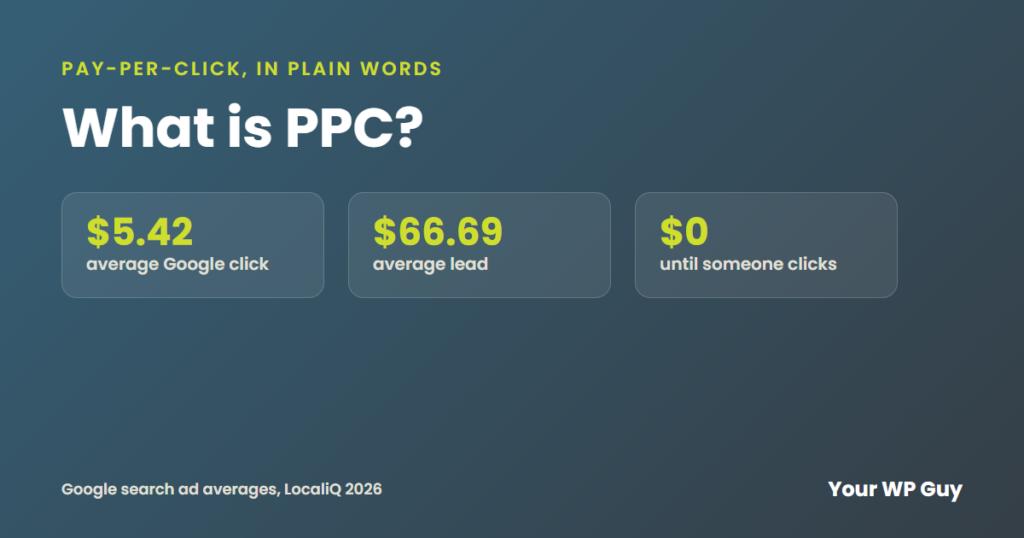
There is no set price, because the auction sets the cost of each click. In LocaliQ's 2026 study of Google search ads, the average click cost $5.42 and the average lead cost $66.69. Lawyers and roofers pay far more than restaurants, so your number depends on your field.
You control the total with a daily budget. Google says that on a busy day it can spend up to twice that budget, but by the end of the month you will not pay more than 30.4 times it. To turn a monthly budget into a daily one, use this:
Daily budget = Monthly budget / 30.4
Example: $3,000 / 30.4 = $98.68 a day
If someone runs it for you, add their fee. Our PPC management starts at $500 a week per platform, plus at least $3,000 a month in ad spend.
Is PPC better than SEO?
Neither one is better, because they do different jobs. SEO earns free spots in search results over time, while PPC pays for spots right now.
| PPC | SEO | |
|---|---|---|
| How fast | Ads can show the same day | Months to build up |
| What you pay for | Every click | The work, not the clicks |
| When you stop | Traffic stops that day | Rankings fade slowly |
| Best for | Testing offers, busy seasons, fast leads | Steady leads that cost less over time |
Most businesses do best with both, since PPC brings in leads while SEO grows. Your ads also show which keywords turn into sales, so your SEO can go after those words first. New to SEO? Read what is SEO.
Is PPC worth it for a small business?
It can be, when a sale is worth more than the clicks it takes to get one. PPC tends to work well when:
- People search for what you sell, like "AC repair near me."
- One new customer is worth a few hundred dollars or more.
- Your landing page loads fast and makes the next step easy.
- You can track calls, forms or sales back to the ad.
It is a harder fit when nobody searches for what you sell, or when one sale is worth less than a few clicks. It also struggles when you can't afford to test for a few months.
The biggest waste we find is money spent on searches that never buy. On one store's Google Ads account in 2026, we cut that share of keyword spend from 56% to 10%, checked against the store's own sales.
How do you start a PPC campaign?
- Pick one goal, like calls, booked jobs or online sales, because one clear goal makes every other choice easier.
- Set up tracking first. Turn on conversion tracking in Google Ads and check it against Google Analytics. We have seen Google Ads count about twice the sales a store really had.
- Send clicks to the right page. Use a page built for that offer, not your homepage. A landing page often pays for itself.
- Choose keywords and negative keywords. Negative keywords block searches you do not want, like "free" or "jobs."
- Set a budget you can keep for 90 days. The first few weeks are for learning what works.
- Check it every week. Look at which searches cost money and which ones bring sales, then cut the losers.
Want PPC run for you?
You did not start your business to watch bids all day. Jonathan watches, checks and verifies every account, with a senior team that helps build campaigns. You own the account, and you get a report and a call every month. Management starts at $500 a week per platform, plus ad spend.
1. Talk to us about your goals and budget. 2. We set up tracking, ads and pages. 3. You get leads you can count, and we cut what does not sell.
Sources
- Google Ads Help, About Ad Rank (checked November 2026)
- Google Ads Help, About Quality Score for Search campaigns (checked November 2026)
- Google Ads Help, how daily budgets are charged (checked November 2026)
- Alphabet, Q4 and fiscal year 2025 results (February 2026)
- LocaliQ, Search advertising benchmarks (2026)
What to do next
Search for your main service and town on Google, and note who shows up in the ads. If your competitors are there and you are not, PPC is the fastest way to join them. It helps your website do its job as your hardest-working employee.
Keep reading: What makes a PPC campaign work? | What is retargeting? | What is SEO?