
What Is a SERP Analysis? How to Read Google’s First Page
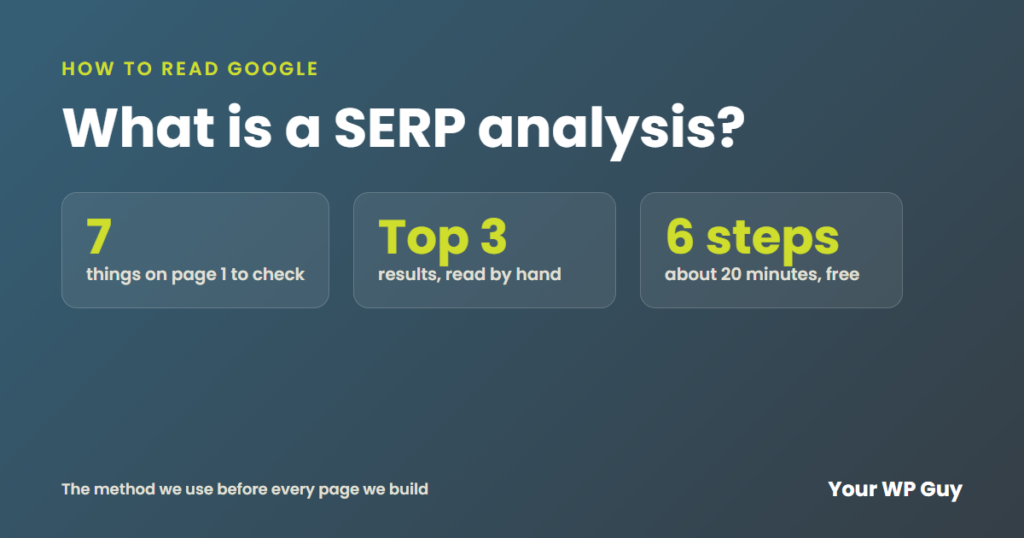
A SERP analysis means searching Google for a keyword you want to rank for and studying what shows up on the first page: the ads, the AI answer, the map, the questions and the top results. It tells you what Google thinks people want for that search, who you are up against and what your page needs to compete. You can do a basic one yourself for free in about 20 minutes. If you want us to do it across all your keywords, see our SEO Research.
Do you ever search for your own service and wonder why other businesses show up and you do not? The answer is usually sitting right there on the first page, if you know how to read it.
We do a SERP analysis before we write any page or post, for our own sites and for clients. Here is what it is, what to look for and what a real one finds.
What is a SERP?
SERP stands for search engine results page, which is the page Google shows after you search. SEO, or search engine optimization, is the work you do so your website shows up higher on that page.
A SERP used to be ten blue links. Today it can include ads, an AI answer at the top, a map with three local businesses, a "People also ask" box, product listings and videos, all before the regular results.
What is a SERP analysis?
A SERP analysis is a close look at the first page of Google for one keyword, where you check what kinds of results Google shows, what the top pages have in common and what they leave out.
It answers three questions:
- What does the searcher want? Someone searching "plumber near me" wants to call someone today. Someone searching "how to fix a running toilet" wants steps.
- What kind of page wins? A service page, a blog post, a product page or a video.
- What would it take to beat them? More detail, better proof, a faster page or answers they skipped.
What can you see on Google’s first page?
Each part of the first page means something different for your business, and each one takes a different kind of work.
| What you see | What it means for you |
|---|---|
| Ads | Businesses pay for this search, so it likely brings in customers. |
| AI Overview | Google answers the question itself, so fewer people click. Being one of the sites it cites is the goal. |
| Map with 3 businesses | A local search. Your Google Business Profile matters as much as your website. |
| People also ask | The questions people ask next. Answer them on your page. |
| Product listings | A shopping search. Online stores need a product feed and Shopping ads. |
| Videos, Reddit and forums | People want real experience. A page with your own photos, numbers and stories fits better than a generic one. |
| Regular results | The pages you compete with directly. Read the top 3. |
Why does a SERP analysis matter for a small business?
It keeps you from building the wrong kind of page for the search you care about. If Google shows a map and three local businesses, a long blog post will not get you into that map. If Google shows how-to articles, a sales page will struggle to rank.
It also shows you where the easy wins are. When the top pages are old, thin or missing an obvious question, a better page has a real chance.
How do you do a SERP analysis?
Here are the six steps we follow for every page we build:
- Search like your customer. Use the words they would type, from your service area, because local results change by location. A private browser window helps keep your own history out of it.
- Write down what is on the page. Ads, an AI Overview, a map, "People also ask", products, videos or forums. Use the table above to see what each means.
- Decide what the searcher wants. To learn, to compare, to buy or to call someone nearby.
- Read the top 3 regular results by hand. Note how long they are, their headings, their numbers and their dates. Skim past forums and videos, but note that they are there.
- List what all three cover. Those topics are the minimum your page needs.
- Find what they miss or get wrong. Old numbers, missing questions, no real examples. That gap is how your page earns its spot.
Then write down your plan for the page before you write a word of it.
What does a real SERP analysis find?
Here are two we did on November 5, 2026, while planning posts for this site.
"Google Ads vs Facebook ads." Google showed an AI Overview, a Reddit thread at #2 and a YouTube video at #4. The #3 result no longer worked as an article, because it now redirects to a sales page. One of the top articles, written in 2023, said Meta may spend 25% over your daily budget. Meta's own help page (checked November 2026) now says up to 175% of your daily budget in a day, and no more than 7 times it in a week. A SERP analysis does not just show you who ranks; it shows you who is out of date.
"How much does SEO cost?" Three of the top seven results were Quora threads. That told us people want plain answers from real people, not a sales pitch, so the page we planned shows real prices. Several articles quoted Google as saying SEO takes "four months to a year." Google's current guide no longer says that, so we left it out.
Want a SERP analysis for every keyword that matters to you?
You did not start your business to study Google results. Our SEO Research checks what Google shows for your keywords, who is ahead of you, what AI answers say about you and what to fix first, in order.
1. Talk to us about your site. 2. We research your keywords and competitors. 3. You get a plan, in order, and a call to walk through it.
What tools can you use for a SERP analysis?
- Google itself (free). The search page is the best tool there is, and everything above can be done with a browser.
- Google Search Console (free). Shows the searches your site already shows up for and your average position.
- Traffic Yeti (ours). Full disclosure: we built it. It tracks rankings, shows where you appear on the map in each part of town and checks what AI tools say about you.
- Semrush and Ahrefs (paid). Show search volume, difficulty and the history of who ranked when.
For more on what each tool does, see the SEO tools we use.
Sources
- Google Search Central, Visual elements gallery of Google Search (checked November 2026)
- Meta Business Help Center, About daily budgets (checked November 2026)
- Google Search Central, Do you need an SEO? (checked November 2026)
What to do next
Pick the one search that would bring you the most customers, and look at its first page with fresh eyes. Then build the page that fits what Google shows, so your website can be your hardest-working employee.
Keep reading: What is SEO? | What is keyword research? | Why is my website not on Google?